Research
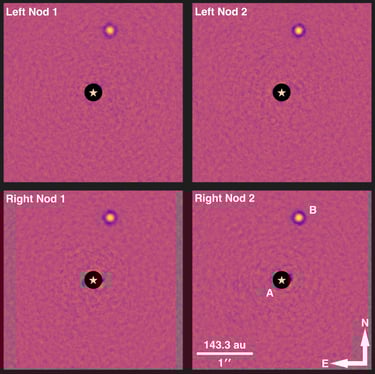
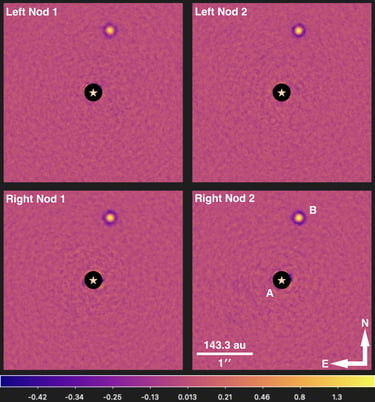
I work on infrared high-contrast imaging, especially with the Large Binocular Telescope Interferometer (LBTI) and its L- and M-band InfraRed Camera (LMIRcam). Thermal infrared observations in the L and M bandpasses (~3-5 μm wavelengths) are optimal for maximizing the brightness of substellar objects, such as giant exoplanets and brown dwarfs, relative to their host stars (i.e., maximal planet-to-star contrast ratios). With excellent adaptive optics (AO) correction and a minimal number of warm optics, the LBTI is uniquely sensitive at these wavelengths—allowing for strong detections of young, self-luminous (proto-)planets and brown dwarfs (see images above!).
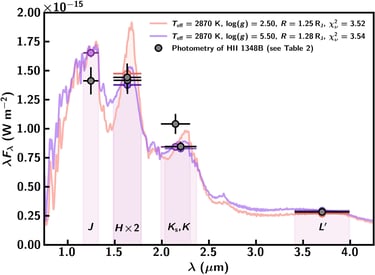
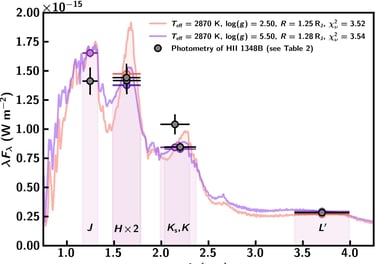
I led a study on HII 1348B published in early 2025, a ~112 Myr-old, high-mass (~61 Jupiter-masses) brown dwarf companion to a binary star in the Pleiades open cluster. The four pink images show the bright yellow (false color) brown dwarf as seen at 3.7 microns with LBTI, across the two 8.4-m apertures (hence, binocular!) and at two telescope pointings. There is also a plot of my fitting of self-consistent atmospheric models to spectro-photometry of HII 1348B in the near-to-mid-IR. We find from the first orbital modeling of this companion that its wide, circumbinary orbit is likely quite eccentric (e ~0.8), hinting at a top-down, star-like formation history and/or a possible dynamical scattering event with the inner binary stars around which it orbits.
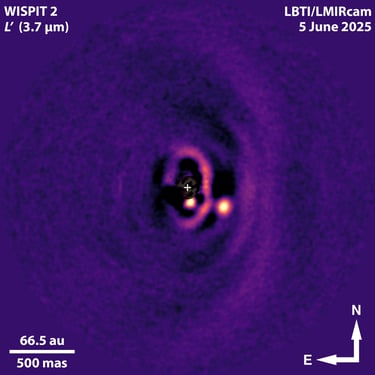
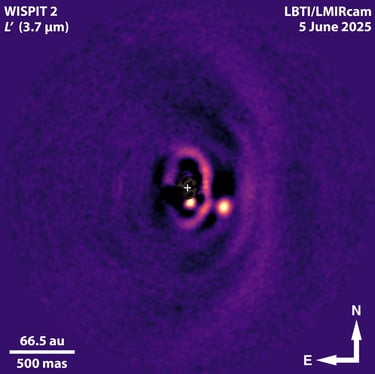
I also contributed to a paper led by Prof. Laird Close on the discovery of the first accreting giant planet clearing a dust-free gap in its surrounding protoplanetary disk, WISPIT 2b. This ~5 Jupiter-mass protoplanet was discovered at Hα with Magellan/MagAO-X following the disk discovery with VLT/SPHERE. I processed and analyzed follow-up L' imaging of the system from the LBTI, which helped our team to infer the mass of this planet from its thermal emission and estimated age. The LBTI imaging also revealed a second bright point source in the inner disk cavity (CC1), which is a candidate 2nd protoplanet in the system. A significant Hα accretion signal from CC1 was not detected, yet it is clearly bright at L' and also visible in weaker detections at Ks and z' . It appears to be too red to be explained by scattered starlight alone, so we propose it may be a 2nd protoplanet, possibly ~ 9 Jupiter-masses, that is more embedded in dust than WISPIT 2b is.